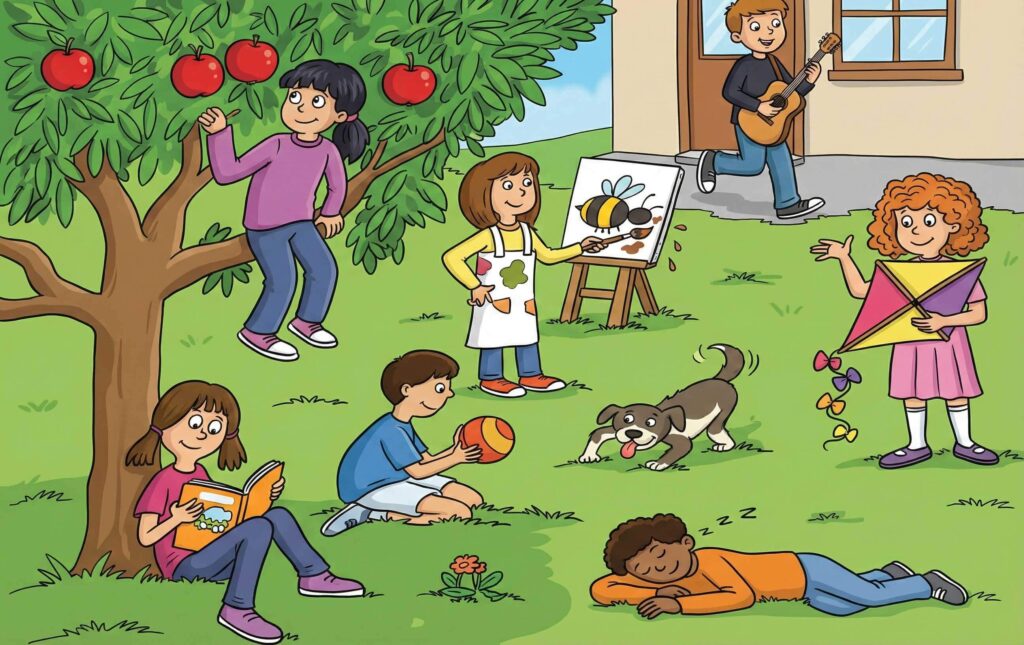
Test 8.1
Library – Fill in the Blanks
Select the correct words from the dropdowns.
Underline (select) the correct answer by choosing from the dropdowns.(English Past Paper)
In a village far away from the city lived a young girl named Pinky. She was an adventurous girl, always seeking new experiences. One sunny day, Pinky found a mysterious map in her grandfather’s bookshelf. She, then, decided to go on a treasure hunt.
Following the clues of the map, Pinky journeyed through a forest crossing a bubbling stream. Along the way, she met many animals who supported her. A wise owl guided her through a dark forest, and a playful squirrel pointed towards a hidden cave.
As Pinky reached the cave, she found a glittering chest filled with gold. She was not interested in it. Excitement filled her heart as she realized the true wealth was the journey itself. She returned to the village with newfound friends and stories to share. Everyone in the village celebrated her adventurous spirit, and Pinky learned that sometimes the greatest treasures are the memories we create and the friends we make along the way.
1. 📖 Vocabulary Development
Firstly, this passage introduces rich words like adventurous, mysterious map, treasure hunt, and glittering chest ✨, helping students expand their descriptive vocabulary in storytelling contexts.
2. 👀 Visual Literacy
In addition, learners can imagine vivid scenes 🖼️ such as forests, bubbling streams, and hidden caves, which strengthen their ability to connect language with mental imagery.
3. 📘 Comprehension Skills
Moreover, the passage enhances comprehension 📖 by requiring students to follow a sequence of events — from finding the map to realizing the true treasure.
4. 📝 Exam Relevance
As a result, this type of narrative mirrors functional English tasks 🧠 often tested in the O/L exam, such as reading stories and identifying themes or morals.
5. 🧩 Guided Learning
Furthermore, the clear storyline ✅ supports learners by modeling how characters, settings, and events are woven together in narrative writing.
6. 🎯 Practical Application
Finally, the passage teaches a life lesson 🌍 — that real treasures are friendships and memories — reinforcing moral values alongside language learning.
Fill in the blanks by selecting the correct words from the dropdowns (English Past Paper).
1. 📖 Vocabulary Development (English Past Paper)
Firstly, this passage introduces everyday travel-related words like platform, departure, arrival, and delay 🚉, helping students expand their vocabulary in a practical transport context.
2. 👀 Visual Literacy
In addition, learners can imagine the train station setting 🖼️ and connect the announcement with real-world travel visuals, reinforcing how language is used in public spaces.
3. 📘 Comprehension Skills
Moreover, the passage strengthens reading comprehension 📖 by requiring students to understand time references, schedules, and the impact of a delay.
4. 📝 Exam Relevance
As a result, this type of announcement mirrors functional English tasks 🧠 often tested in the O/L exam, such as interpreting notices and instructions.
5. 🧩 Guided Learning
Furthermore, the clear structure of the announcement ✅ supports learners by modeling how information is presented formally and politely in public communication.
6. 🎯 Practical Application
Finally, the passage blends language with real-world travel situations 🌍, reinforcing functional English and logical reasoning — key goals of the GCE O/L syllabus.
Read the text below and select the correct number of the answer from the dropdowns.
The world’s largest mammal is the blue whale. Although they can breathe air, blue whales are most at ease in the ocean, where their ability to float supports their amazing size. These marine animals can be found in every ocean of Earth, and they frequently swim alone or in tiny groups. A blue whale calf is born weighing two tons (approximately 1814kg) and during its first year of life, it gains an additional 200 pounds (approximately 91 kg) every day. These enormous animals consume krill, which are tiny organisms that resemble shrimp. It is estimated that just a small number of blue whales inhabit the oceans worldwide. They were nearly driven to extinction because of years of hunting for their oil and blubber. Although they were shielded from extinction by the 1966 International Whaling Convention, they are currently listed as endangered.
| Topic | Choose Number |
|---|---|
| (1) A swimming style of whales | |
| (2) A common prey of whales | |
| (3) What hunters seek in whales other than oil | |
| (4) The extra weight a calf gains every day in its first year | |
| (5) The weight of a calf at birth | |
| (6) The year that ensured the safety of whales |
1. 📖 Vocabulary Development (English Past Paper)
Firstly, this activity introduces everyday English words like thermometer, umbrella, and sunglasses 🕶️, helping students expand their vocabulary in a practical context.
2. 👀 Visual Literacy
In addition, by matching descriptions to pictures 🖼️, students learn to interpret visual cues and connect them with language — a skill tested in the O/L English exam.
3. 📘 Comprehension Skills
Moreover, the task strengthens reading comprehension 📖 by requiring students to understand short descriptive phrases and identify their meanings accurately.
4. 📝 Exam Relevance (English Past Paper)
As a result, this format mirrors actual exam questions 🧠, making it ideal for revision and familiarizing students with picture-based vocabulary tasks.
5. 🧩 Guided Learning
Furthermore, including a completed example ✅ supports learners by reducing confusion and modeling how to approach the task correctly.
6. 🎯 Practical Application
Finally, the activity blends language with real-world objects 🌍, reinforcing functional English and logical reasoning — key goals of the GCE O/L syllabus.
Choose the correct answer
1. 📖 Vocabulary Development (English Past Paper)
Firstly, this activity introduces everyday English words like thermometer, umbrella, and sunglasses 🕶️, helping students expand their vocabulary in a practical context.
2. 👀 Visual Literacy
In addition, by matching descriptions to pictures 🖼️, students learn to interpret visual cues and connect them with language — a skill tested in the O/L English exam.
3. 📘 Comprehension Skills
Moreover, the task strengthens reading comprehension 📖 by requiring students to understand short descriptive phrases and identify their meanings accurately.
4. 📝 Exam Relevance (English Past Paper)
As a result, this format mirrors actual exam questions 🧠, making it ideal for revision and familiarizing students with picture-based vocabulary tasks.
5. 🧩 Guided Learning
Furthermore, including a completed example ✅ supports learners by reducing confusion and modeling how to approach the task correctly.
6. 🎯 Practical Application
Finally, the activity blends language with real-world objects 🌍, reinforcing functional English and logical reasoning — key goals of the GCE O/L syllabus.

Choose the correct answer
1. 📖 Vocabulary Development (English Past Paper)
Firstly, this activity introduces everyday English words like thermometer, umbrella, and sunglasses 🕶️, helping students expand their vocabulary in a practical context.
2. 👀 Visual Literacy
In addition, by matching descriptions to pictures 🖼️, students learn to interpret visual cues and connect them with language — a skill tested in the O/L English exam.
3. 📘 Comprehension Skills
Moreover, the task strengthens reading comprehension 📖 by requiring students to understand short descriptive phrases and identify their meanings accurately.
4. 📝 Exam Relevance (English Past Paper)
As a result, this format mirrors actual exam questions 🧠, making it ideal for revision and familiarizing students with picture-based vocabulary tasks.
5. 🧩 Guided Learning
Furthermore, including a completed example ✅ supports learners by reducing confusion and modeling how to approach the task correctly.
6. 🎯 Practical Application
Finally, the activity blends language with real-world objects 🌍, reinforcing functional English and logical reasoning — key goals of the GCE O/L syllabus.
1. 📖 Vocabulary Development
Firstly, this activity introduces everyday English words like thermometer, umbrella, and sunglasses 🕶️, helping students expand their vocabulary in a practical context.
2. 👀 Visual Literacy
In addition, by matching descriptions to pictures 🖼️, students learn to interpret visual cues and connect them with language — a skill tested in the O/L English exam.
3. 📘 Comprehension Skills
Moreover, the task strengthens reading comprehension 📖 by requiring students to understand short descriptive phrases and identify their meanings accurately.
4. 📝 Exam Relevance
As a result, this format mirrors actual exam questions 🧠, making it ideal for revision and familiarizing students with picture-based vocabulary tasks.
5. 🧩 Guided Learning
Furthermore, including a completed example ✅ supports learners by reducing confusion and modeling how to approach the task correctly.
6. 🎯 Practical Application
Finally, the activity blends language with real-world objects 🌍, reinforcing functional English and logical reasoning — key goals of the GCE O/L syllabus.
1. 📖 Vocabulary Development (English Past Paper)
Firstly, this activity introduces everyday English words like thermometer, umbrella, and sunglasses 🕶️, helping students expand their vocabulary in a practical context.
2. 👀 Visual Literacy
In addition, by matching descriptions to pictures 🖼️, students learn to interpret visual cues and connect them with language — a skill tested in the O/L English exam.
3. 📘 Comprehension Skills
Moreover, the task strengthens reading comprehension 📖 by requiring students to understand short descriptive phrases and identify their meanings accurately.
4. 📝 Exam Relevance (English Past Paper)
As a result, this format mirrors actual exam questions 🧠, making it ideal for revision and familiarizing students with picture-based vocabulary tasks.
5. 🧩 Guided Learning
Furthermore, including a completed example ✅ supports learners by reducing confusion and modeling how to approach the task correctly.
6. 🎯 Practical Application
Finally, the activity blends language with real-world objects 🌍, reinforcing functional English and logical reasoning — key goals of the GCE O/L syllabus.
1. 📖 Complete Guide for Students (English Past Paper)
At first, The Sri Lanka GCE O/L English Syllabus – Complete Guide for Students provides a clear overview of the skills and knowledge required for success in the examination. It helps learners understand what areas they need to focus on and how to prepare effectively.
2. 📝 Exam Syllabus in Sri Lanka
Furthermore, the GCE Ordinary Level English Exam Syllabus in Sri Lanka outlines the essential areas of study, including grammar, vocabulary, comprehension, and literature. As a result, this ensures students know exactly what topics will be tested.
3. 📚 Study Resources (English Past Paper)
After that, Students can benefit from the Sri Lanka O/L English Language Syllabus and Study Resources, which offer structured practice materials and guidance for exam preparation. On the other hand, these resources include notes, worksheets, and practice papers.
4. ✍️ Grammar, Vocabulary, Literature & Tips
Then, to strengthen performance, the O/L English Exam Syllabus Sri Lanka – Grammar, Vocabulary, Literature & Tips highlights key focus areas and practical strategies. This section emphasizes exam techniques and common mistakes to avoid.
5. 📂 Past Papers & Preparation Guide
Finally, the Sri Lanka GCE O/L English Syllabus 2025 – Past Papers & Preparation Guide ensures learners have access to updated exam formats, marking schemes, and practice questions. Past papers are a vital tool for building confidence and achieving success.